Showing posts with label Advanced Review Copies-Book Review. Show all posts

Friday, 26 September 2008

The Gargoyle by Andrew Davidson

Did The Gargoyle by Andrew Davidson change my life, open eyes to a world unlived, sweeten my lips until my last breath, well no. But was it an enjoyable read, fading the world’s troubles ,to refresh for the grind of job, and family-you bet it was. The story is essentially a rewrite of Beauty and the Beast but fellows don’t dismiss it as chick-lit. It’s your turn to say “I'll have what she's having” as it’s also skilfully weaves in comedy and mystery with twists.

The story opens with the unnamed narrator, an adult movie mogul and porn stud high on drugs and liquor crashing and burning in a car accident. To describe the pain and the impact he asks you to put your hand on a live electric element:
And hold it there. Hold it there as the element scorches Dante’s nine rings right into your palm, allowing you to grasp Hell in your hand forever. Let the heat engrave the skin, the muscles the tendons; let it smoulder down to the bone. Wait for the burn to embed itself so far into you that you don’t know if you’ll ever be able to let go of the coil. It won’t be long until the stench of your own burning flesh wafts up, grabbing your nose hairs and refusing to let go, and you smell your body burn.
I want you to keep that hand pressed down for a slow count of sixty. No cheating. One Mis-sis-sip-pi, two Mis-sis-sip-pi, three Mis-sis-sip-pi… At sixty Mis-sis-sip-pi, your hand will have melted so that it now surrounds the element, becoming fused with it. Now rip your flesh free.
The honest story of recovery from severe burn trauma becomes one theme of the novel. He is crippled emotionally by depression and self-loathing rooted an appalling childhood and drug abuse. He fired only by the hope of getting out of the hospital to finish killing himself. A strange woman from the Mental Heath wards in for schizophrenia and bi-polar break down befriends him and he sees her as a way out,

So you ask, what about the mystery element? Well as the recovery progresses she starts telling a myth-story that reveal deeper secrets or madness. It remains ambiguous until the end of the story if this is a supernatural story of eternal love or a natural love of two very screwed up people. Each time you think you have the line it will slip away from you. As light relief you also have a comedy love story about another couple linked to different historical myth/stories. But pay attention, as all the themes and story strands knit together to give you an unexpected ending.

It’s not a hard story to hold in your head as I snatched reading time from travelling around the country meetings in a very busy week. The clever plotting meant that the move between the now and then and between the characters backstories keep you interested and the writing build pictures for your mind to play with, parallels of the now and then from the morality of the narrator, to the role of friends and livelihoods also help to keep the pages turning.

I would highly recommend it, and if you and partner get a copy( it’s the credit crunch so time to share so you have spare) you could cuddle up on a cold evening. Sip wine and read aloud to each other by candle-light (well I would so ask him). It’s cleverly aimed at a broad market so expect the film (once they have sorted out the nude scenes-some hot and some very yuk!) in 2010 with Angelina Jolie and Johnny Depp in the lead roles. You heard it here first!

Sunday, 7 September 2008

“The White War: Life and Death on the Italian Front 1915-1918" by Mark Thompson

I have just finished reading “The White War: Life and Death on the Italian Front 1915-1919" by Mark Thompson which is a study of a 1st World War front that is often forgotten but where Italy lost 689, 000 solders( Britain lost 662,000 + 140, 000 reported as missing). That we tend to associate the infantry war with the plains of Flanders and Russia reveals the common myth as this part of the struggle was mountain warfare albeit also with trenches.

The conduct of the war exposed the weak hold of liberal structures and politics on the Italian population and the defeat of victory quickly let in 20 years of fascist government. The collapse of the Austrian-Hungarian Empire, and take over the successor national states by the communists has made it difficult to get a sense of what really went on: Italians and other non Germanic nationals did fight for the Emperor, many of the feature of Fascism (a puppet parliament, a muzzled press, a romantic nationalism, a militarised state) had their roots on the political conduct of the war.

What made the book an interesting read is that Mark Thomas does more then hold to the historical arc of the events from the turmoil in Italy leading to its ripping up of a long standing agreement to be allied with the Central Powers of Germany and Austria-Hungary ( It took on a secret 30 pieces of silver territorial deal with the Allies). And ending with the desperate mad dash to occupy land vacated by the collapsing Hapsburg armies-it made the most of the cock-up where as the armistice agreement ended the war one day earlier for Austria-Hungary. What he does is switch the narrative in cinematographic terms from wide/long shots, medium to close-ups as the narrative unfolds. So we take the long view at the ideas affecting Italian practice in politics, art and military such as Romantic Vitalism or the ideas of Friedrich Nietzsche. Or the impact of how Italian unification actually unfolded. We then have medium shot accounts of how individual battles unfolded from both of the combatant’s perspectives or the power struggles and conduct at military and political levels. And finally the close-up accounts of artists, reporters, and survivors that expose the official accounts or help to explain the mindset of the elites.

It was this rounded and varied explanation that held my attention, as I tended to wander in the step by step of accounts of the battles(my attention span rather then the quality of the writing, although these are necessary to understand the appalling and arrogant way that the soldiers were used. For example, Military discipline justified the ancient Roman practice of randomly killing 1 in 10 solders if the platoon had infringed any rules which could be just turning up late from leave. The fact, with no interest shown in the reason was enough for summary execution. This is because the Italian army leadership took the most extreme view of all the armed forces in the 1st world war that the solders were only cannon fodder to do the will of the supreme commander. An attitude they paid for when Austria-Hungarian forces with direct support of Germany developed a forerunner of Blitzkrieg and took back all the territory fought over in the past three years and swept down to the pre 1866 national boundaries.

The resource imbalance between the foes and the deteriorating political realties for the Central Powers meant that this could not be turned into a knock-out blow. But with Russia out and embroiled in Revolution and no significant Allied victories, the collapse of the Central Powers as Germany struggled to avoid the fate of Austria- Hungary created the German Nazis myth of a stab in the back. It also confirmed the lack of democratic populist support for liberalism.

So why should you read this book? Well it gives you a clear account of one part of the wider First World War front that is only now becoming clear and even possible to study. (Attempts to clear the names of those summarily executed is still politically sensitive in Italy.) But a more important reason is that it offers insights into the conduct of events now. If History has anything to teach, its that we the ordinary people wont get a true picture what our masters have been doing in our name until we are pushing up the daisies.. In knowing what was going on behind closed doors then, we can question what the media, cultural elites, military strategists, politicians are doing now. But of course if you think we have the straight line on the War on Terror, or the credit crunch then give it a miss.

Sunday, 20 July 2008

Country of the Grand by Gerard Donovan

Gerard Donovan is that cliché, an Irish writer with a poet’s sensibility. His 2003 debut novel was Schopenhauer's Telescope: trucks arrive with frighten, crying villagers, one man digs a hole, one watches. The result is a stunning and moving discussion that covers everything from the life of Genghis Khan to what exactly, is a hole.

In contrast, his recently published collection of short stories, Country of the Grand, uses musical and witty language to convey the lives of ordinary people in a changing Ireland. Morning swimmers, it’s about the loss of old school friends becoming strangers but it’s also about the compromises we make in marriage to keep the hope of love alive. A theme picked up in How long until when a man driving seeing a Life Assurance advert is prompted to ask, how long would you wait before you slept with someone so revealing marriage fault-lines. In other stories such as Shop lifting in the USA we discover the awful lie that the relationship is founded on or in Archaeologists see a relationship in its dying moments. In the Country of the Grand we follow, the events of one evening in the successful and empty live of a lawyer as he acts on the impulse of trying to find the landscape of his childhood. Many of the stories move from the thoughts and actions of the moment to a reflection of the past or as in Glass looking at the pain of a widow through the eyes of her accusing teenage son.

Gerard Donovan is clearly a writer worth reading if you like poetic prose and imaginative stories based on intelligent thought. But the collection of stories suffer as any collection of short stories does by being a random collection of writing enjoyed in the moment of the train journey but once collected together the signature of the writer becomes that much more obvious so less startling or stimulating.

Gerard Donovan use of language and imagery, hover between poems and prose,an good example of this is By Irish Nights . You circle over Ireland following road travellers over one night including those who won’t return as this extract illustrates.

...But those three children. A small breath of water makes a sea of the lungs and sinks the breath.

They found themselves after in languid palms that rested upright in the still water, and they hadn’t drowned. They found themselves in hands sometimes covered in swans that floated, shaped in rain drops that shook the surface of the sky where it rested in the water, in the hold of a father as he taught them to walk, in a mother’s patience as she fed them from spoons and dressed them for the morning. And then they found themselves at last, carved into the endless hearts that lost them, waking every night to sleep.

Its an interesting paradox of our time that in the panic that we can only cope with flash-card writing, short stories are in long decline as we prefer the narrative depth of novels. However, these facts may not be in contradiction, as short stories as poetry require good writing and good reading (close attention to language and structure) to work. Read this collection and decide if its bad writing or poor reading that shapes its future.

Saturday, 28 June 2008

The Collector of Worlds by Iliya Troyanov

When a book opens with a single cinematic sweep, moving from Sir Richard Burton death through the reluctant giving of last rites, to a sharp focus on a burning photograph of the 22-year-old Richard Burton that pulls you into his 1840's Bombay, you know you are in for a treat. This book is The Collector of Worlds by Iliya Troyanov just published in the UK translated by William Hobson but originally published in Germany in 2006. The book is not a Biography, History or a novel but a biographical fiction meaning as the author says that the live and works of Sir Richard Burton inspired him because all

…individual lives are mysterious, particularly those of people one had never met. This Novel is intended as personal approach to a mystery rather than as an attempt at definitive revelation.

This approach shapes the unusual structure of the novel. It is divided into three sections: first is Burton's service in India in 1842-49, second is his travels in disguise to Mecca and Medina as a pilgrim on the hajj (1851-53)and concludes with his journey from Zanzibar to Lake Tanganyika in 1858 as he attempted to discover with a fellow explorer the source of the Nile. So we don't know his life before or after this period or even during this period when away from waving the Flag.


In each section, Burton’s reveals his thoughts through a third-person monologue whilst other narrators offer context or even contrasting views. Burton acts as the antagonist to these characters where as his is the culture or landscape of India, Arabia and Africa. In the Indian section, these others are Lahiya, a professional letter-writer, to whom Burton's one-time servant Naukaram goes to have his story written up, in the hope of gaining further employment. It’s soon clear to Lahiya that Naukaram is not telling the whole truth and as we see neither is Burton. In the Arabian section, a script like exchange between various Islamic officials, suggests that he spied on military positions. Perhaps he did, or perhaps they fear the loss of rich pickings as the long slow decline of the Ottoman Empire gave opportunities for the politically unscrupulous. The African section narrator is another historical character Sidi Mubarak Bombay, we meet him as a old man telling stories to his friends and relatives. He was a slave working in India before gaining his freedom and returning to Madagascar and becoming a key figure in most of the big exploratory expeditions of the time into East Africa. Through him, we explore the conflicting motives and styles for the Speke and Burton expedition to find the source of the Nile.


The language is poetic with scene after scene evoked with powerful physical detail and a constant parade of realistic characters from a long faded 19th Century that engage us in both Burton’s life as well as the other narrators. Together each section reveal a complex ambiguous man who loved language, disguises, adventure, learned to love sex, and wanted to understand cultures for the wider benefit of the Empire without perhaps realising the irony that Empires once they see the worth of other cultures the right to rule begins to crumble.


I strongly recommend the book for a highly enjoyable read and an introduction to a man well worth reading and in many ways a man ahead of his time.


Thursday, 12 June 2008

Yellow Fever by Steffan Piper


Yellow Fever is a self-published book by Steffan Piper sent to me for review by the author some weeks ago. As such, I have gone into more plot detail then usual, as you are unlikely to come across the version I have read.

The story is about denial, obsession and its consequences. Don’t expect weepy mismatched love or hopeful redemption but do anticipate a skilful portrayal of one very mixed up complex woman who in many ways is bigger then the novel. Qianqian (pronounced chin-chin) is a young Asian woman, who is a stripper and lap dancer. We meet her, debating the rules for her first working appointment outside of the strip club. She thinks along the lines of you can knock at the door but not open it. Well that her intention but by the end of the evening she is knocked, opened and well and truly entered. Result: large dollop of spending money, duped boss, suckered self and betrayed boyfriend.

She may be a working girl but Steffan is no Richard Gere. (The hotel room she goes to is from the Pretty Woman film so clearly warning no fairy-tale endings as echoed throughout the book by references to The Princess Bride, a 1987 film which Steffan loves and Qianqian hates). He is Los Angeles cop involved in dodgy official undercover telephone tapping and illegally writing anonymous celebrity gossip. Oh and divorced from his Korean wife (an ex stripper) who happens to be Qianqian best friend. We are definitely in the underbelly of American Life.

A core of the unfolding tragedy is that Steffan thinks he knows the worse that Qianqian can be-he is mistaken. By the end of the story, her behaviour results in the death of one lover and the ruin of another, her parents reject her (Incidentally, this scene is very powerfully written) and she is on her journey to being a headline corpse.

The structure of the novel is a series of mainly well-written scenes told from both Qianqian and Steffan’s perspective as their lives cross and part over several months. You find out about their back-stories as they meet other characters or play bedroom games. This results in detailed characterisation that has the fascination of car crash TV.

But does it work? Yellow Fever has some minor flaws and two serious flaws. Clearly, still work in progress explains the sprinkling of typos and the irritating initial rash of film star names or the overlong chess references. (NB sport like cultural references assume that the reader shares the same knowledge, if they don’t that’s an audience lost!) One personal niggle for me is page 15 where Steffan talks about a Felixstowe described as being known for its Norman Churches…on the eastern seaboard! Please, it’s a run down Victorian seaside town, home of one the biggest ports in Europe on the East Coast. And did we drink Earl Gray in the 1980’s?

The serious flaws are its lack of resolution and audience focus. Part of this for me is calling the main character after the author. This sets up a dashed expectation that the novel is going to about the act and art of writing as in a John Barth or Peter Auster novel. As suggested at the beginning, Qianqian develops into a compelling character whose behaviour links to past traumas. The reason for Steffan’s behaviour is less clear but the fundamental flaw is that the storylines remained unresolved, Qianqian drifts and Steffan chases and…and?

Now in real life this happens, we live with loose ends unresolved but in a novel, it makes for a loss of dramatic tension. If this is the purpose of the book then reflect it in the novel’s structure. For example, have the narrators talk about their past and so we gain a glimpse of the future whatever it is. It may work out for them, Qianqian may break her destructive pattern or not, or make her fortune in the sex industry. This lack of resolution for me raises the second flaw, who is the audience for the novel? It’s too well written for sex summer blockbuster, too raunchy and gloomy for chicklit, and too character driven for action-bonk supermarket fodder. Steffan can write and even this flawed novel is worth it for much of the writing but more attention is needed for what is commercial, do this, and we may yet see his name on the bestseller list.

Sunday, 18 May 2008

The Contractor by Charles Holdefer


To appreciate this book you have to ignore the misleading hype on the cover that suggests that The Contractor by Charles Holdefer exposes the secret detention and interrogation system expanded and ran by the Bush Administration outside of US and international law. It is political book but not at the level of who is doing what to whom. Instead, it goes to the heart of the western moral and ethical war aims as raised in this passage:

Then the LORD said to Cain, “Where is Abel your brother?" And he said, "I do not know. Am I my brother's keeper?"

It is clear that George Young, civilian interrogator contractor and a veteran of the first Gulf war would say no. His reaction when he comes across the burnt out remains of the Revolutionary Guard convoys is to argue:

…Because that day, I learned the price. Sure, I was shaken and sickened, and it is something I’d rather not think about or dwell on, but it also taught me something, steeled me, gave me the resources necessary to understand politics in the grown up world and later to become a contractor. This is what I learned: what we take for granted, hold precious, and celebrate remains viable because of our willingness to do this…To let those men get away would’ve been a serious strategic mistake…Any other description is special pleading or making excuses. Or simply lying to oneself. It gives me no satisfaction to say so, but not only will innocents die-they must die.

The story starts with the consequences of this when in a powerful opening scene we discover how prisoner #4141 dies. The humanity of the Prisoners are denied, as they are merely oranges being crated when they arrive or faceless numbers.

George Young is not a monster, which would let us off the hook so the story needs to show us why a good man would get to that position. It does in that we discover the economic and family pressures that lead systematically to meaningless death. We learn about his poor business track record and happy second marriage (which is being slowly killed by his need to keep secrets). The political playing out of the theme is also examined in his personal life as his big brother is his keeper at key points.

Away from the heat of the desert island and in the cold of a mid west winter on a family Christmas visit we have the amusing and poignant scenes of having to tackle the Father in Law( think of Spencer Tracy at his most grumpy) a minister of a struggling flock and a die in the wool fundamentalist. The family idea of fun is Bible Baseball ( questions are asked with the harder they are the more runs they are and George and his son are clueless). At one level this as they are trapped by the snow falls illustrates the horror that prisoners have to face. Unlike them, he escapes and answers a call by his brother, which sets of a chain of events where he finally does decide that he is his brother’s keeper.

The story moves between George’s professional and family life in the now and with flashbacks so that we understand his actions. The other characters are sketched in nicely which make the horrors of the camp and the choices he has to make even more chilling. The use of language and jargon is also clever and the first person POV gives you the reader chance to understand his world whilst questioning it.

If it makes more of us aware of the travesty of a war on terror for Democracy, and Human Rights based on lies and torturing rather then the politics of being my brother’s keepers then I hope it gets the wider readership it deserves.

Other points of view:
One persons journey through a world of books
Writing...writing...writing...what else is there?

Friday, 25 April 2008

Jasmine's Tortoise by Corinne Souza

Jasmine’s Tortoise is the first novel of Corinne who has written non fiction books about her family’s involvement in spying and her experiences as a lobbyist during the Major-Blair years. It is clear that much of Corinne Souza life is woven into the novel’s mix of fictional and historical events that unfolds from1965 to 2002. Souza’s father is clearly used as a source for Jasmine’s father and she like Jasmine owes her British passport to the spy trade.

The book covers 40 turbulent years from the ellipse of the Puppet Hashemite monarchy by secular Arab nationalism to its eventual challenge by Islamic militancy and Kurdish nationalism. These local changes are shaped if not controlled by the ebb and flow of the big three imperial powers: Britain, America, and Russia, who gradually became the big two and then finally in the 90’s just the big one. These complex social and political changes are explored through the fates of three families: the Palameries- Roman Catholic Indian traders, the Solomon’s, the last of Bagdad’s old Jewish families and the El-Tareks- a well heeled Muslim family with a presence in the old and emerging social-political elites.

The story starts in Bagdad when the British niceties of Masonic lodges, Horse Racing, dances and formal parties, are in the final throes of death with a family party. Tragedy is triggered when Jasmine is given a tortoise by her grandfather. Peter Ligne, the local MI6 bureau spymaster claims it from him. This hurts her grandfather’s feelings so his friend Nico Stollen, the KGB spymaster, is pulled into a rivalry to protect Jasmine. Thus starts a struggle for her “soul” that will see betrayal and death rip the families apart mirroring the wider betrayal of Iraq. Forty years later the younger generation and older family survivors fight for Jasmine’s redemption as Nico Stollen and Peter Ligne pull the strings to the final moments.

The book is structured with a prologue setting out all the main characters and their relationship in 2002 before diving back to Bagdad in 1965. It then jumps in linear stages to 2002 and we follow the twists and turns of the characters as they die, marry, betray and manipulate with bitter and unintended consequences. Expect lots of twists and unexpected turns as the plot sets a good pace as you keep a track on who is who. If in doubt dip back to the prologue as the characters and their relationships are set out as if a route map.

Clearly an ambitious and multi-layer story so does it work? Only partly has to be the honest answer. The flaw is that the writing does not match the ambition of the story. The characters are often two-dimensional, and clichés with barely distinguishable voices but they do serve as effective pegs to move the plot on at a quick pace. And who complains when Fleming and Agatha Christies characters serve the same purpose?

We also have a POV that switches character within the same page as well as an irritating habit of the writer as untended narrator explaining words and actions. This would have been fine in a historical account but not in a novel as it all adds to effect of the reader being distant and observing rather then participating in the story. Again fine as long as the reader is interested in plot rather then character driven stories.

So is the plot credible? The opening prologue is over complex and slows the introduction to the story; this could have perhaps been better handled perhaps as a press interview of Jasmine so become a narrative that intrigues us. Nor do we have the back story of why key central characters are so loyal to each other. The importance given to British Intelligence, Masons and Employer associations stretches credibility. But Lodges were in the British Middle East until closed down in the mid 60’s, and until the 90’s employees with a radical past were black-listed and British intelligence did play dirty tricks with the Labour Party. And as for the corruption of the Government sponsored arms trade just read the latest news headlines! So the story is an exaggeration and simplification of the truth which will irate some readers but not all.

In the end, the potential fatal flaw of the novel is who is the intended readership? In wanting to explore the ambivalent moral and political issues of the modern world, it suffers in comparison with Graham Greene who managed to combine serious literary acclaim with wide popularity. Yet it lacks the technically detailed espionage and military science storylines of say a Tom Clancy or the focus on one heroic man, or a small group of crusading individuals, in a struggle against powerful adversaries of say a Robert Ludlum. Despite these reservations and limitations it is still a good holiday read but given a good cast, and screenplay it would really work as a mini commercial TV series.


Sunday, 13 April 2008

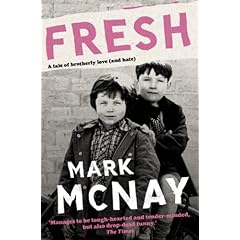
Fresh by Mark McNay

This is Mark McNay’s first novel and clearly draws on first hand knowledge of the day to day grind of a certain working class life where a full belly, a warm fire and a good woman is perfection. It fits within a British tradition of “kitchen sink realism” kicked of by John Osbourne’s “Look back in Anger” in the 50’s that looks at the dreams and anger of the working class man and woman. Think of Alan Sillitoe’s Saturday night and Sunday morning or the film work to the current day of Ken Loach and Mike Leigh, both of whom continue to create powerful films unafraid of tackling head on current social problems.

The story follows a day in the life of Sean working in a chicken packing factory**, who discovers that his Brother Archie has come out of jail early ( in for violence and drugs related crime). This sets up a chain of events with tragic consequences as Sean has spent most of a money clip he was banking for his brother. He desperately struggles during the course of the day to borrow the money from family and from the firm. The novel also by flashbacks reveals Sean’s and Archie’s childhood and life up to the events of the day. Sean is no angel; he gambles, takes a more or less willing part as a pick up in his brother’s drug’s network and will use his fists. But unlike his brother does with his family needs in mind- his own and that of his uncle and aunt who gave him a home when his father left and mother died. And it’s for his family that he has to fight for as the day develops.

The story unfolds through a lot of dialogue and switches between first and third person perspectives rather then description although we get’s Sean’s flights of imagination for colour. The dialogue is written in Glaswegian but it doesn’t jar and often it’s in the silences between characters that speak more. The speech patterns (expect sentences where F**k can be a noun, verb, adjective and have several meanings from love to hate! and the mundane events of the day convey tenderness, violence and humour in scene after scene with warm believable characters.

It’s remarkable that the author started a creative writing course in his late forties in 1999 which lead to this award winning (Arts Foundation New Fiction 2007) novel. Hope for all us yet! It is by no means perfect, as the ending is a little flat and the characterisation of Archie teeters on the edge of caricature but it’s an easy page turner and I can’t wait for the Ken Loach channel four adaptation that surely must be in pre production talks as you read this!

** and you may want to rethink eating cheap value chicken after reading the book!

Saturday, 8 March 2008

Scenes from a Revolution: The Birth of the New Hollywood by Mark Harris


Scenes from a Revolution: The Birth of the New Hollywood is traced through the events that lead to the production and nomination of “In the Heat of the Night", "Bonnie & Clyde", "Doctor Doolittle", "Guess Who's Coming to Dinner" and "The Graduate” for the best picture in the Academy Awards Ceremony of 1967. As you read it you become painlessly enmeshed in the practical nuts and bolts of movie making as well as the political, social and technological changes affecting their production and distribution. It is clearly based on meticulous research and interviews so you get both the contemporary take on things and the older and perhaps wiser reflections on events of many of the main characters.

The context is that Hollywood in the mid 60’s was still mainly organised as factory-studios with the exception of United Artists that was a publisher-distributor (a producer put a creative package together and agree costs and profits and UA marketed and distributed.) But the whole system was in reality the walking dead. Before the mid 50’s back to the 30’s 5 of the 8 big studios also controlled the theatres. This link was broken by a 1948 Supreme Court ruling that required exhibition to be separate from distribution-production. This system had allowed the studios to do block booking which was usually a package of 5 films- one good and the rest a range of A and B stinkers. It was this practice that the judgement had ruled on. The solution was seen a divorcement which RKO as one of the weaker studio had jumped on for its own advantages so forcing a chain reaction of separation. Ironically, it was the first to be broken up by an outside conglomerate, stripped of its film assets and finally came out of the movie industry completely.

The studio’s economic model was churning out colour, bright light big screen westerns, war and sex-comedies (think John Wayne, Doris Day) and the occasional musical aimed at families. TV was seen as the big competitor and a destroyer of its mass market so they resisted allowing films being distributed to TV. Directors would even sue them because the commercial breaks were affecting the artistic balance of the film. The big earner in this economic model was to have a road movie. This was a film that would open in the big theatres with booked seats charging above average prices and would only be released to the next range of theatres when the income started to fall. In this way a film could be an income stream for 2 years. However in the 60’s the big road movie had been the Sound of Music so the studios were falling over to produce the next big expensive musical most of which were to be box office turkeys and become the final nail in the coffin for the studio-factory system.

Another factor in this light fare was the aftermath of McCarthyism with the Studios steering away from anything political despite the obvious major social revolutions taking place due to the Civil Rights movement, the growing anti war movement and the baby boom generational cultural revolutions. The production code also imposed self censorship and meant that films were increasingly at best out of touch or at worse reactionary. For example, afro-Americans appeared in films as servants and nowhere behind the scenes with the exception of Sidney Poiter as the “good Negro” had which itself reflected the racism of the time of which Sidney Poiter was fully aware.

Yet by the 70’s this whole economic model had changed. All the studios had become distributor-producers with close links to TV’ production and distribution. They were all on they way of being absorbed into conglomerates. The summer blockbuster had arrived, and franchises (think Bond, Jaws, Planet of the Apes, StarTrek) were integral to profits. The key market was no longer families but the 15-21’s, censorship was replaced with ratings. Integration behind and in front of the camera took off as Hollywood realised the economic power of its black audience. And they embraced European film making and styles.

Don’t think this is a dry history book as much of this context is woven into the real heart of the book which is to look at the twists and turns of the stages of the films production. The structure is like a novel in that you read so far in the events of a movie before switching to another often by following how the events in the one gave or frustrated opportunities in the other. This list gives you a flavour of the complexities of making a move and the serependity of the results.

  • Screenplay- Bonnie and Clyde by writers who wanted the film to be the start of American New wave. Or ones that started as novels adaptations such as the Graduate. What is hot or not then depends on what is seen as the next big book office which what drives the Doolittle project

  • The Producer-Doolittle and the Bonnie and Clyde film had a rocky ride before this became clear. What is hot is not depends on how well you did so Kramer could get a package for Guess who coming to dinner but Warren Beatty could not but his charm proved to be the winner

  • The Director. Bonnie and Clyde had a very bumpy two years before Penn agreed to come on aboard. And the graduate Director had never shot a film and had only just become known as a Theatre Director after years of being part of a famous comedy team. What is hot is not depends what was hot in the book office so knowing a turkey was on the way a number of projects were driven to get things moving before the money moved away.

  • Casting-biggest breaker and maker of the process as the bankable star could prove a disaster in making or distributing the film as Rex Harrison for Doolittle. Or make as in the case of Hepburn and Tracey in Guess who’s coming to Diner. You also see the turkeys that might have been- Doris Day as Mrs Robinson and Robert Redford as the boy in the Graduate

  • Production-pre, filming and post production. It becomes clear the importance of lighting, choosing locations, editing all had a powerful impact on the final films and how the decisions taken were shaped by the civil right struggle, the power of the studio, changes in the production code etc

  • Distribution and the critics- Warner Brothers tried to bury Bonnie and Clyde- it had got as far as it did because Jack Warner in the last few weeks of being the last old time Studio Boss had been distracted by the making of Camelot. But a powerful critic going into print acknowledging that he had been mistaken in his first review gave Warren the chance to start the year long campaign to get an eventual successful national release

And before you now think that this is a nerd’s book, added to the film history, social and political context and analyses of how films actually get made (kills dead any auteur theory which holds that a director's films reflect that director's personal creative vision) a detailed biography of the key actors, producers, studio bosses directors, writers, technicians etc and their relationships to each other as the films finally get made and shown is woven into the story. For example: Scenes from a Revolution: The Birth of the New Hollywood is traced through the events that lead to the production and nomination of “In the Heat of the Night", "Bonnie & Clyde", "Doctor Doolittle", "Guess Who's Coming to Dinner" and "The Graduate” for the best picture in the Academy Awards Ceremony of 1967. As you read it you become painlessly enmeshed in the practical nuts and bolts of movie making as well as the political, social and technological changes affecting their production and distribution. It is clearly based on meticulous research and interviews so you get both the contemporary take on things and the older and perhaps wiser reflections on events of many of the main characters.

The context is that Hollywood in the mid 60’s was still mainly organised as factory-studios with the exception of United Artists that was a publisher-distributor (a producer put a creative package together and agree costs and profits and UA marketed and distributed.) But the whole system was in reality the walking dead. Before the mid 50’s back to the 30’s 5 of the 8 big studios also controlled the theatres. This link was broken by a 1948 Supreme Court ruling that required exhibition to be separate from distribution-production. This system had allowed the studios to do block booking which was usually a package of 5 films- one good and the rest a range of A and B stinkers. It was this practice that the judgement had ruled on. The solution was seen a divorcement which RKO as one of the weaker studio had jumped on for its own advantages so forcing a chain reaction of separation. Ironically, it was the first to be broken up by an outside conglomerate, stripped of its film assets and finally came out of the movie industry completely.

The studio’s economic model was churning out colour, bright light big screen westerns, war and sex-comedies (think John Wayne, Doris Day) and the occasional musical aimed at families. TV was seen as the big competitor and a destroyer of its mass market so they resisted allowing films being distributed to TV. Directors would even sue them because the commercial breaks were affecting the artistic balance of the film. The big earner in this economic model was to have a road movie. This was a film that would open in the big theatres with booked seats charging above average prices and would only be released to the next range of theatres when the income started to fall. In this way a film could be an income stream for 2 years. However in the 60’s the big road movie had been the Sound of Music so the studios were falling over to produce the next big expensive musical most of which were to be box office turkeys and become the final nail in the coffin for the studio-factory system.

Another factor in this light fare was the aftermath of McCarthyism with the Studios steering away from anything political despite the obvious major social revolutions taking place due to the Civil Rights movement, the growing anti war movement and the baby boom generational cultural revolutions. The production code also imposed self censorship and meant that films were increasingly at best out of touch or at worse reactionary. For example, afro-Americans appeared in films as servants and nowhere behind the scenes with the exception of Sidney Poiter as the “good Negro” had which itself reflected the racism of the time of which Sidney Poiter was fully aware.

Yet by the 70’s this whole economic model had changed. All the studios had become distributor-producers with close links to TV’ production and distribution. They were all on they way of being absorbed into conglomerates. The summer blockbuster had arrived, and franchises (think Bond, Jaws, Planet of the Apes, StarTrek) were integral to profits. The key market was no longer families but the 15-21’s, censorship was replaced with ratings. Integration behind and in front of the camera took off as Hollywood realised the economic power of its black audience. And they embraced European film making and styles.

Don’t think this is a dry history book as much of this context is woven into the real heart of the book which is to look at the twists and turns of the stages of the films production. The structure is like a novel in that you read so far in the events of a movie before switching to another often by following how the events in the one gave or frustrated opportunities in the other. This list gives you a flavour of the complexities of making a move and the serependity of the results.

  • Screenplay- Bonnie and Clyde by writers who wanted the film to be the start of American New wave. Or ones that started as novels adaptations such as the Graduate. What is hot or not then depends on what is seen as the next big book office which what drives the Doolittle project

  • The Producer-Doolittle and the Bonnie and Clyde film had a rocky ride before this became clear. What is hot is not depends on how well you did so Kramer could get a package for Guess who coming to dinner but Warren Beatty could not but his charm proved to be the winner

  • The Director. Bonnie and Clyde had a very bumpy two years before Penn agreed to come on aboard. And the graduate Director had never shot a film and had only just become known as a Theatre Director after years of being part of a famous comedy team. What is hot is not depends what was hot in the book office so knowing a turkey was on the way a number of projects were driven to get things moving before the money moved away.

  • Casting-biggest breaker and maker of the process as the bankable star could prove a disaster in making or distributing the film as Rex Harrison for Doolittle. Or make as in the case of Hepburn and Tracey in Guess who’s coming to Diner. You also see the turkeys that might have been- Doris Day as Mrs Robinson and Robert Redford as the boy in the Graduate

  • Production-pre, filming and post production. It becomes clear the importance of lighting, choosing locations, editing all had a powerful impact on the final films and how the decisions taken were shaped by the civil right struggle, the power of the studio, changes in the production code etc

  • Distribution and the critics- Warner Brothers tried to bury Bonnie and Clyde- it had got as far as it did because Jack Warner in the last few weeks of being the last old time Studio Boss had been distracted by the making of Camelot. But a powerful critic going into print acknowledging that he had been mistaken in his first review gave Warren the chance to start the year long campaign to get an eventual successful national release

And before you now think that this is a nerd’s book, added to the film history, social and political context and analyses of how films actually get made (kills dead any auteur theory which holds that a director's films reflect that director's personal creative vision) a detailed biography of the key actors, producers, studio bosses directors, writers, technicians etc and their relationships to each other as the films finally get made and shown is woven into the story. For example:

  • Hepburn and Tracey may have been gay or bisexual and in a protective relationship- being adulterous being the better option!;

  • Rex Harrison and wife were very fun of the sauce- she when drunk would do flipovers wearing no knickers;

  • Sidney Poiter was used as an Uncle Tom by the film industry but his films shown on the TV( sold by the studios as worthless negro films) widened his audience appeal and encouraged TV companies to Black Actors in positive roles as in Mission Impossible and Startrek);

  • Dustin Hoffman went back onto welfare until the Graduate was released and capitulated him into and stardom and the Midnight Cowboy; and

  • David Webb the author admits how priggish he was in the film’s changing the scene so the wedding is distributed after the vows and not before the vows as in the book

This was an extremely enjoyable book that enabled me to see these 1967 films and films in general in a new light. Its 500 pages flew by as I managed to read it over 4 days and was left begging for more. Highly Recommended.

Friday, 22 February 2008

My Soul to Keep by Melanie Keep

Melanie Wells is a Texan and a psychotherapist in marriage and family therapy and comes from a musical family which contributes to her rhythm of writing. She is also clearly a traditional Christian as this shapes the book imagery, plot and narrative. As a consequence don’t expect natural street talk as the bad guys don’t curse although this is not handled in a clumsy way.

The novel seen as psychological thriller/mystery is the 3rd in a series: the first was When Day of Evil Comes when the 30 + redhead female hero, Dylan Foster a psychology professor in a Christian University, is framed for a murder and the second is The Soul Hunter which deals with a Psychotic stalker. The events and characters of first two are echoed and hinted at throughout this novel but it does stand alone. A constant theme in the three books is the fight between good and evil which is reflected in the every day fact that she is plagued by a demon called Peter Terry and helped by a guardian angel. She also prays and talks to God, has psychic insights from dreams etc. And to be fair it’s hinted at and suggested rather then clichéd white robes and wings or red eyes and horns.

To be honest not my type of Christianity but think TV shows where angels drift in to people’s lives and help them resolve emotional and ethical concerns rather then Buffy the vampire slayer. You don’t have to see this traditional Christian view as real and true as I am sure many bible-belt Americans would but as part of a narrative world to which you the reader enters. No difference really in entering the peculiar 1950’s Agatha Christie’s English social world of country houses, weekend parties, dressing for dinner, afternoon teas etc.

The story starts with a picnic in a park (the smart park rather then the local run down one) with Dylan out with two friends and their young children. Nicholas’s mother had been raped by the stalker from The Soul Hunter but had kept the child (anti abortion and forgiveness message). Christine the little girl is deeply sensitive to the supernatural and her parents are rich but caring- father and brothers out delivering aid and the bible to the staving masses (a rich man can enter the kingdom of heaven). Then Nicholas is snatched from the park and the hunt begins to save his life. USA statistics show that more then 76% of abducted children are killed within three hours of the abduction so tension amounts as time seeps away

Christine the little girl was also snatched but then rejected as the wrong one as we find that she is psychically linked to the fate of Nicholas. Dylan struggles to make sense of the events as they unfold whilst dealing with her stalled career and hapless love life. And the past comes back facing her to deal with issues left hanging in the previous stories.

Don’t expect big plot twists as this is a narrative and character driven story. Both of which are done well in a made for TV movie sort of way. It’s not cutting edge existential metafiction…and thank god for that I hear many of you say. Would I recommend it? Well it’s not a book I would have chosen to read as it was an Advanced Readers Copy sent to me for a review. I am not a fan of Mystery/Crime writing or supernatural going on so was I the wrong person to be contacted!! But actually I enjoyed it and may even read the first two as I warmed to the Dylan Foster character and can see the potential for a good TV series along the lines of Ghost Whisper.

Sunday, 9 December 2007

Boy A by Jonathan Trigell

Boy A by Jonathan Trigell was first published in 2004 but reissued this year as being filmed for Channel 4. Despite its title, it is not of the “I had an awful childhood but survived so that you could feel good” genre. It’s a fictional account of Jack (Boy A) and the events that lead up to and from his release from prison on license. He was a child murder of a child…or was he? Think of the 10 year old child murders of James Bulger in 1993 and the consequences should one of them try and rehabilitate back into society as adults. The crime paid for…but can the murder of an innocent ever be paid for? Is revenge more important then justice or forgiveness?

This is not a fractional account of what if, rather it explores the notion of what is evil and that love need actions for it to be love. However, it does this not by heavy moralizing and cut out figures that act as pegs for this or that idea. But is a post modernist novel in that we jump into other characters heads, and go up and down time over 26 chapters that follow the alphabet. But fear not, you don’t have to rush back to your Agatha Christie as this creates a sense of foreboding and suspense.

During the course of the story we get inside Jack’s head as he struggles to understand the world he has not seen since he was 10, and adjust to having a best friend (Chris) and even a girlfriend (Mitchell). But all the time his secret holds him back so he can never be truthful, never real with them. He is helped by his probationary officer (Terry), who genuinely cares for him and stands by him but at the expense of his own son’s welfare with tragic consequences. In and out of this story we also find out what Boy A and Boy B did and the if’s and what’s of Boy A’s deeds. We also see the consequences of parents not caring for their child and the indifferences of schools to bullying. But also us , the general public, and our responses to cases like this and the newspaper campaigns we support that forget the child and man as we become a lynch mob.

I found it a genuine page turner from the first few sentences that grips you with an urgency of trying to discover who and what the betrayal will be. Its short sentences, switches in time and character move the story along so that in the end you have to try and deicide if it’s a battle of Evil versus Good. Or is it the battle that each of us face in tying to relate to others in love?

So would I recommend it? Well if you want cloying sentimentality, or a morality of black and white this is not the book for you. But if you want one that explores moral ambiguity and what love if not explored honesty leads to, then this is the book for you.